OINP Points Calculator
Ontario is the most popular destination for immigrants in Canada. To manage the high volume of applications, the Ontario Immigrant Nominee Program (OINP) uses a specific scoring system called the Expression of Interest (EOI).
Many applicants confuse this with the federal CRS score. They are different.
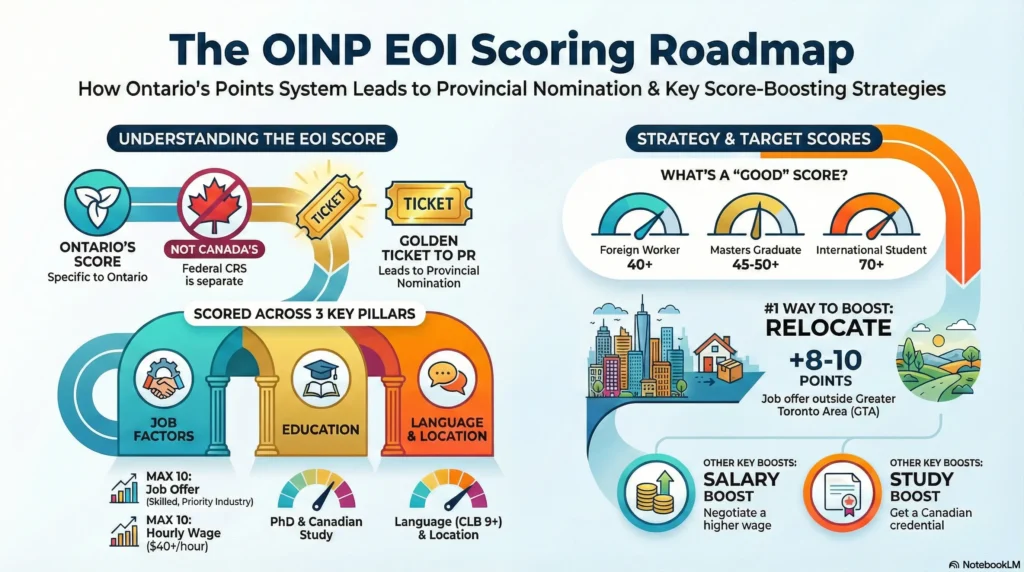
While the CRS score ranks you for all of Canada, the OINP points calculator ranks you specifically for Ontario. A high score here can lead to a provincial nomination, which is often the “golden ticket” to Permanent Residency.
This guide explains the OINP EOI points grid used for the Employer Job Offer streams and International Student streams (Masters/PhD Graduates).
Table of Contents
What is the OINP EOI System?
The OINP Expression of Interest (EOI) is a points-based system. You register your interest, get a score based on your profile, and wait for an OINP draw.
- Total Points Available: Varies by stream (typically roughly 100-110 points max depending on factors).
- Passing Score: There is no fixed “pass” mark. The cutoff changes with every draw (e.g., one draw might require 35 points, another might require 70).
Note: This calculator applies to:
- Employer Job Offer: Foreign Worker Stream
- Employer Job Offer: International Student Stream
- Employer Job Offer: In-Demand Skills Stream
- Masters Graduate Stream
- PhD Graduate Stream
(Note: The Human Capital Priorities stream uses your Express Entry CRS score, not this grid.)
Detailed Breakdown: OINP EOI Scoring Factors
The OINP grid is divided into three main categories: Employment/Labour Market, Education, and Language/Regionalization.
1. Employment / Job Offer Factors
Ontario prioritizes candidates who have good jobs lined up, especially in skilled positions requiring high wages.
NOC Skill Level (TEER Category)
Your job’s National Occupational Classification (NOC) code determines these points.
| NOC TEER Category | Points |
|---|---|
| TEER 0, 1, 2, or 3 (Skilled trades, management, professional) | 10 |
| TEER 4 or 5 (Intermediate/Labour roles) | 5 |
Broad Occupational Category (NOC Type)
Certain industries get priority.
| Occupational Category | Points |
|---|---|
| NOC 0 (Management), 2 (Natural/Applied Sciences), 3 (Health), 7 (Trades), 8 (Resources), 9 (Manufacturing) | 10 |
| Other NOCs (Business, Finance, Administration, Art, Sales, Service) | 5 |
Wage Level
This is unique to Ontario. The higher your hourly wage, the more points you get. (Note: For the Masters/PhD stream, this is calculated based on potential earnings).
| Hourly Wage (CAD) | Points |
|---|---|
| $40.00 per hour or higher | 10 |
| $35.00 to $39.99 | 9 |
| $30.00 to $34.99 | 8 |
| $25.00 to $29.99 | 7 |
| $20.00 to $24.99 | 6 |
| Less than $20.00 per hour | 5 |
2. Education Factors
Ontario rewards higher education and specific fields of study that support the economy.
Level of Education
| Education Level | Points |
|---|---|
| PhD (Doctoral) | 10 |
| Masters Degree | 8 |
| Bachelors Degree (or equivalent) | 6 |
| College Diploma / Trade Certificate (2+ years) | 5 |
| One-year Certificate | 3 |
Field of Study (Canadian Credentials Only)
If you studied in Canada, the subject matters. STEM and Trades get priority.
| Field of Study | Points |
|---|---|
| Engineering / Engineering Technology | 10 |
| Health Care | 10 |
| Math / Computer Science | 9 |
| Trades | 9 |
| Business / Admin / Arts / Humanities | 6 |
| Social, Legal, Education, Science | 5 |
Canadian Education Experience
| Number of Credentials | Points |
|---|---|
| More than one Canadian credential | 10 |
| One Canadian credential | 5 |
3. Language & Regionalization Factors
This section is critical in 2026. Ontario heavily incentivizes people to move outside the GTA (Greater Toronto Area).
Official Language Ability (CLB)
You must take an approved test (IELTS/CELPIP/TEF/TCF).
| CLB Level (English or French) | Points |
|---|---|
| CLB 9 or higher | 10 |
| CLB 8 | 6 |
| CLB 7 | 4 |
| CLB 6 or lower | 0 |
Bonus: Knowledge of Official Languages (2 languages) = +5 to +10 points.
Regional Immigration (Location of Job or Study)
This is the most important strategic factor.
| Location | Points |
|---|---|
| Northern Ontario (e.g., Thunder Bay, Sudbury) | 10 |
| Other Areas Outside GTA (e.g., Ottawa, Hamilton, Windsor, Kitchener) | 8 |
| Inside GTA (Toronto, Peel, York, Durham, Halton) | 3 |
| Inside Toronto (City of Toronto specific) | 0 |
Example: Calculating Points for “Sarah”
Let’s see how the OINP calculator works for Sarah.
- Profile: Sarah has a job offer as a Software Engineer (NOC 2) in Waterloo (Outside GTA).
- Wage: $42/hour.
- Education: Bachelor’s Degree (Foreign).
- Language: CLB 9.
The Calculation:
- NOC Skill (TEER 1): 10 points
- NOC Category (STEM): 10 points
- Wage ($40+): 10 points
- Education (Bachelor’s): 6 points
- Field of Study: 0 points (Degree is foreign)
- Language (CLB 9): 10 points
- Location (Outside GTA): 8 points
Total OINP Score: 54 Points. Verdict: This is a very strong score. In recent OINP draws, scores in the 40s and 50s are often invited, especially for STEM roles outside Toronto.
Strategies to Improve Your OINP Score
If your score is low (e.g., below 35), consider these strategies:
- Move Outside the GTA: Moving your job offer from Toronto to a city like Hamilton or London gives you an instant +8 points (vs 0 points for Toronto).
- Negotiate Salary: If you are earning $39/hour, negotiating a raise to $40/hour gains you +1 point.
- Study in Canada: Taking a 1-year certificate in a high-demand field (like Trades or Health) adds points for Education Level, Field of Study, and Canadian Experience.
Frequently Asked Questions (FAQ)
Q: What is a good score for OINP?
A: It varies by stream.
- Foreign Worker: 40+ is generally competitive.
- International Student: 70+ is often needed due to high competition.
- Masters Graduate: 45-50+ is a safe target range.
Q: Does the OINP score guarantee nomination?
A: No. It guarantees you will be considered in the next OINP draw. If invited, you must then submit a full application proving your claims.
Q: Can I use the OINP points calculator for the Human Capital Priorities (Tech Draw)?
A: No. The Human Capital stream uses your Federal CRS score. This calculator is for the EOI streams (Job Offer / Graduate streams).
Conclusion
The OINP Points Calculator is your roadmap to Ontario. By understanding the heavy weight placed on Wage and Location, you can tailor your job search to maximize your points.
Call to Action: Ready to calculate? Review the grid above, check your NOC code, and start planning your move to Ontario today.